Systems & Interfaces
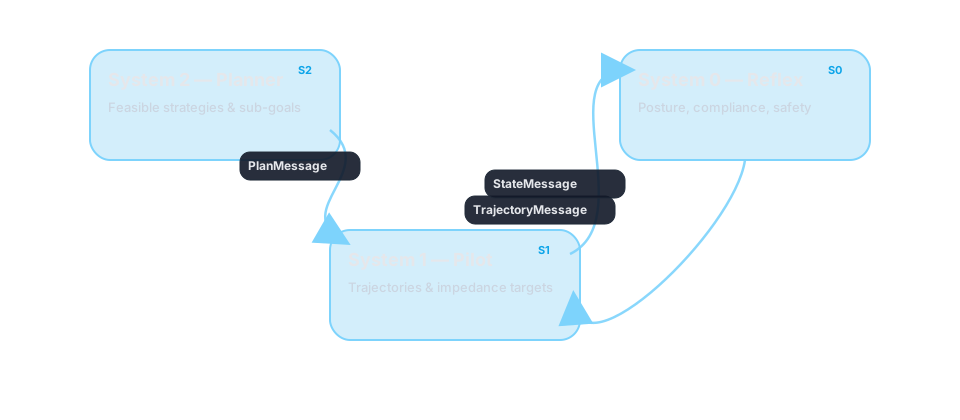
System 2 — Planner
Transforms goals and world context into feasible strategies. The Planner decomposes high-level missions into embodied, monitorable sub-goals that System 1 can act on. It filters out infeasible options, explains its reasoning, and adapts when the world shifts faster than expected.
- Latency: 200 ms – 10 s
- Inputs: goals, scene graphs, multimodal context, constraints
- Outputs: structured plans and sub-goals
- KPIs: task success, plan optimality, explainability, zero safety violations
System 1 — Pilot
The Pilot is the fast intelligence that steers the robot in real time. It translates perception and affordances into smooth, robust trajectories, reacting within tens of milliseconds. Where the Planner sets intent, the Pilot executes—balancing agility, stability, and responsiveness.
- Latency: 10 – 100 ms
- Inputs: local state, short-horizon predictions, affordances
- Outputs: trajectories & impedance targets
- KPIs: intercept accuracy, smoothness, robustness
System 0 — Reflex
The Reflex is the robot’s physiological foundation: millisecond reflexes that stabilize posture, manage compliance, and enforce safety. Like a biological spinal cord, it runs below conscious planning yet underpins all higher reasoning. Without the Reflex, nothing else stands.
- Latency: 1 – 5 ms
- Inputs: IMU, encoders, force/torque, tactile signals
- Outputs: motor commands & reflex events
- KPIs: zero falls, thermal/power safety, joint tracking error, uptime
Interfaces
- Planner → Pilot: PlanMessage
- Pilot → Reflex: TrajectoryMessage
- Reflex → Pilot/Planner: StateMessage + reflex events